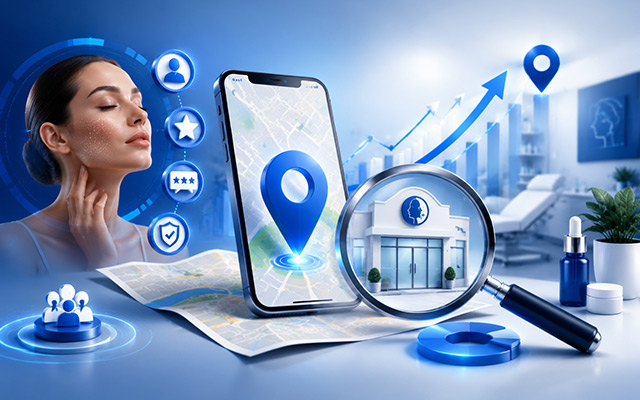
A dermatology clinic can have skilled doctors, modern equipment and satisfied patients—and still remain almost invisible on Google Maps. Clinical quality builds trust after discovery; it does not automatically create search visibility.
Google needs consistent evidence about your services, location and online prominence. Effective local marketing connects Google Business Profile optimisation, website SEO, reviews and location-specific content.
Why Do Some Clinics Show Up on Google Maps While Others Don’t?
When someone searches “dermatologist near me”, Google does not simply display the clinic with the best treatment outcomes. It identifies the most relevant local options for that particular searcher. This is why effective digital marketing for clinics must address visibility before expecting the clinic’s clinical reputation to drive enquiries.
A clinic may rank in one neighbourhood but disappear a few kilometres away. Another may appear for “acne treatment” but not “hair loss doctor”. The difference comes from the query, searcher location, profile information, reputation and website strength.
What Are Google’s Actual Ranking Factors for Local Search?

Google groups local search ranking factors into relevance, distance and prominence. No legitimate shortcut guarantees a better organic position. Professional healthcare SEO services strengthen the signals a clinic can control while recognising that proximity affects individual results.
What Does “Relevance” Mean for a Clinic’s Google Ranking?
Relevance measures how closely a clinic’s information matches the patient’s search. A profile listing acne, pigmentation, hair-loss and laser services gives Google more context than one containing only “skin clinic”.
Categories, services, the profile description and the linked website page should reflect real offerings. Google confirms that selected Business Profile categories affect local ranking, making category choice strategic.
How Much Does Proximity Actually Matter?
Proximity is the distance between the searcher and the clinic. It explains why rankings vary across neighbourhoods and devices. A clinic cannot optimise its way into being physically closer to every patient.
It can strengthen visibility across a realistic service area through accurate location details, useful local pages and stronger prominence signals. Checking rankings only from the clinic reception desk gives a distorted picture.
What Is “Prominence” and Why Do Bigger-Looking Practices Rank Higher?
Prominence reflects how established a clinic appears. Google considers signals such as reviews, links and information across the web. A practice with authoritative mentions, local pages and steady feedback may appear more prominent than one with a thin digital footprint.
“Bigger-looking” often means more complete and trusted online—not physically larger.
Why Is Google Business Profile the Most Important Ranking Factor for Clinics?
For Maps visibility, the Google Business Profile for dermatologists is usually the highest-leverage starting point.
What Happens If Your GBP Categories or Service Details Are Incomplete?
An incomplete profile limits the searches Google can confidently match with your clinic. Frequent gaps include the wrong primary category, missing secondary categories, outdated hours, absent appointment links and weak service descriptions.
Complete every relevant field truthfully. Add original photographs, update hours, describe services clearly and link each profile to the most relevant location page. Never add promotional keywords to the business name unless they are part of the genuine name.
Why Do Reviews Matter More Than Most Clinics Realise?

Reviews influence visibility and patient choice. Google says more reviews and positive ratings can support local ranking. Structured online reputation management helps clinics request feedback ethically, respond professionally and identify recurring patient concerns.
Can a Clinic with More Reviews Beat One with a Higher Rating?
Yes, but not automatically. A clinic with 300 recent reviews and a 4.7 rating may outperform one with 20 reviews and a 5.0 rating when its relevance, proximity and profile strength are also better.
Google considers review quantity and positive ratings, but rankings depend on combined signals. Volume cannot compensate for an irrelevant profile or distant location.
What Common Mistakes Are Costing Clinics Their Local Rankings?
The costliest SEO mistakes for medical practices are often basic: duplicate profiles, incorrect categories, conflicting contact details, thin branch pages, neglected reviews and websites that fail to explain treatments clearly.
Is Inconsistent NAP Information Hurting You?
NAP consistency for clinics means keeping the name, address and phone number accurate across the website, Google profile, directories, social pages and medical listings.
Minor formatting variations are rarely catastrophic. Conflicting phone numbers, old addresses and inconsistent names confuse patients and weaken confidence. Google’s guidelines generally allow one profile per eligible business location.
Is a Slow or Outdated Website Quietly Hurting Your Rankings?
A slow, confusing or non-mobile website can weaken organic visibility and conversions. Patients may leave before booking, while thin pages give Google little evidence of relevance.
Good healthcare website design should prioritise fast loading, mobile usability, doctor credentials, treatment information, branch details and clear appointment actions. Google says its systems reward a good overall page experience.
Why Does Google Hold Medical Websites to a Higher Standard?
Medical pages can influence health decisions, so anonymous advice, unsupported claims and poorly sourced treatment content create a major trust problem. Dermatology websites should demonstrate experience, expertise, authoritativeness and trustworthiness—commonly known as E-E-A-T.
Show doctor qualifications, medical reviewers, clinic addresses, update dates and balanced explanations. Avoid guaranteed results and sensational claims. Google uses E-E-A-T as a framework for assessing helpful, reliable content; its quality-rater guidelines are not a direct ranking switch.
How Should Multi-Branch Clinics Approach Local SEO Differently?
Each genuine branch needs its own eligible Google Business Profile and dedicated webpage with the correct address, phone number, hours, doctors, services and directions. Google advises one profile per business location and offers bulk-management options for larger groups.
Do not duplicate the same paragraph across every page. Patients in Salt Lake have different location cues from those in Gariahat or Minto Park. Each page should remain useful and locally specific.
How Long Does It Actually Take to See Results from Local SEO?
Technical corrections may produce movement within weeks, but meaningful improvement commonly requires several months. Timing depends on competition, profile history, review activity, website condition and the clinic’s starting position.
Local SEO for clinics is not a one-time setup. Measure calls, direction requests, appointment enquiries, profile actions and location-level rankings—not one vanity keyword.
Why Should You Work with a Digital Marketing Agency in Kolkata for This?
A specialist digital marketing agency in Kolkata for dermatologists understands that healthcare search marketing requires more than generic keyword placement. It requires accurate medical communication, ethical reputation building, branch-level tracking and coordination between profiles, website pages and patient journeys.
MfunL builds a practical local SEO strategy for medical practices around search demand, locations, service priorities and measurable enquiries. The goal is helping the right patients discover the right branch and take action.
What Should Your Dermatology Clinic Do Next?
Audit the fundamentals: profile completeness, categories, NAP data, reviews, branch pages and website trust signals. Local visibility is earned through connected evidence, not isolated tricks.
MfunL, a digital marketing agency in Kolkata for dermatologists, helps dermatology clinics turn nearby searches into qualified appointment opportunities.
Consult our digital marketing experts today.
People Also Ask
1. What is local SEO and why does it matter for clinics?
It improves visibility for location-based searches, helping nearby patients find relevant clinic services.
2. What are Google’s main ranking factors for local search?
Google identifies relevance, distance and prominence.
3. How important is Google Business Profile for a clinic’s ranking?
It is central to Maps' visibility because it provides categories, services, location data, hours and reviews.
4. Do more reviews help a clinic rank higher than fewer, better reviews?
Reviews can help a clinic rank higher, but the count alone does not determine rankings. Rating, relevance, proximity and other profile signals also matter.
5. What is NAP consistency, and why does it matter for SEO?
It keeps the clinic’s name, address and phone number dependable across online platforms.
6. How long does it take to see results from local SEO?
Early movement may appear within weeks, while competitive and sustainable growth usually takes several months.
7. Why do multi-location clinics need a different SEO approach?
Every branch competes in a different area and needs its own eligible profile and useful location page.
8. What is E-E-A-T, and why does it matter for medical websites?
It stands for experience, expertise, authoritativeness and trustworthiness—qualities that help medical content demonstrate credibility.
9. Can a clinic rank well without a strong Google Business Profile?
It may rank organically for some searches, but competing consistently in Maps becomes much harder.
10. What are the most common local SEO mistakes clinics make?
Incomplete profiles, wrong categories, duplicate listings, inconsistent NAP data, neglected reviews and weak branch pages are among the most common problems.